Guide for parents
The KS2 spelling test, explained for parents
The KS2 spelling test is Paper 2 of the Year 6 English grammar, punctuation and spelling SATs. It has 20 words worth one mark each. The teacher reads each word inside a sentence, then on its own, then in the sentence again, and the child writes it into a gap on the answer sheet. The paper takes about 15 minutes and is sat in May.
Its 20 marks are added to the 50 from Paper 1 (grammar, punctuation and vocabulary) and converted to a scaled score between 80 and 120. A scaled score of 100 is the expected standard. This guide explains where the words come from, how the score is set, and what a year of unhurried practice looks like.
What the spelling paper looks like
Each of the 20 questions is a single sentence with one word missing. The administrator reads the target word, then the full sentence, then the word again. Children fill the gap by hand. There is no multiple choice and no word bank, which is why the paper is closer to dictation than to a worksheet.
The paper is not strictly timed; the Standards and Testing Agency guidance says it should take approximately 15 minutes, and schools allow children to finish. Handwriting only needs to be legible. A reversed b is marked as a b; a word with the right letters in the wrong order is marked wrong.
Where the 20 words come from
The words are drawn from the spelling content of the national curriculum, set out in English Appendix 1: Spelling. Appendix 1 has two statutory word lists, one for Years 3 and 4 and one for Years 5 and 6, each of 100 words, plus the rules and patterns each year group is expected to have covered. A Year 6 paper can test anything from Year 2 onward, so because is fair game alongside necessary.
In practice the papers lean on a recognisable set of patterns.
| Pattern | Examples | Appendix 1 year |
|---|---|---|
| -tion, -sion, -ssion, -cian endings | station, decision, discussion, musician | Year 3–4 |
| Silent letters | knight, island, doubt, solemn | Year 5–6 |
| Homophones | their / there, practice / practise, whose / who's | Year 3–6 |
| -ough spellings | through, thorough, cough, bought | Year 5–6 |
| -cious / -tious | delicious, ambitious, cautious | Year 5–6 |
| ei after c | receive, deceive, ceiling | Year 5–6 |
| Suffix doubling and -fer | referring, preferred, reference | Year 5–6 |
| Prefixes | disappear, misspell, irregular | Year 3–4 |
How the scaled score works
Raw marks from both papers (out of 70) are converted to a scaled score each year, so that 100 always means the same standard even when one year's paper is harder. The conversion table is published after the tests. Scores run from 80 to 120; 100 or above is "met the expected standard", and below 100 is "working towards".
There is no separate pass mark for spelling on its own. A child who scores 18 out of 20 on spelling but struggles on grammar can miss the standard, and the reverse is true. That is worth knowing before you put every spare minute into spelling: it is worth 20 of the 70 marks.
| Scaled score | Meaning |
|---|---|
| 80–99 | Working towards the expected standard |
| 100 | Expected standard met |
| 101–109 | Expected standard met, with room above it |
| 110–120 | Working at greater depth (the "higher standard") |
A year of practice, month by month
The most useful thing about the KS2 paper is that the standard is a threshold, so practice can aim at it directly. Here is a plan that starts in September of Year 6 and does not involve a single past paper until spring.
| Months | Focus |
|---|---|
| September–October | Find the real level with a mixed dictation. Rebuild Year 3–4 patterns if needed; nobody marks you down for revising them. |
| November–December | The Year 5–6 statutory list, ten words a week, dictated in sentences and marked by letter. |
| January–February | One rule a week: silent letters, -ough, -cious/-tious, ei/ie, doubling. |
| March | Homophones in sentences. First full practice paper, untimed, just to learn the format. |
| April | Two more practice papers. Everything wrong goes into the daily review pile. |
| May | Light dictation only. Sleep. |
Practising the way the paper is read
Read the word, then a sentence with the word in it, then the word again. Say it plainly, in your normal accent, and do not stretch the syllables to help. The point of the sentence is meaning: it tells the child that practice is a noun this time. Let them write by hand, because that is what the answer sheet requires.
Mark by letter, not with a cross. Neccessary is one letter wrong, and the child needs to see which one. The ten-minute dictation routine sets this out step by step, including how often a missed word should come back.
Where Word Wonder fits
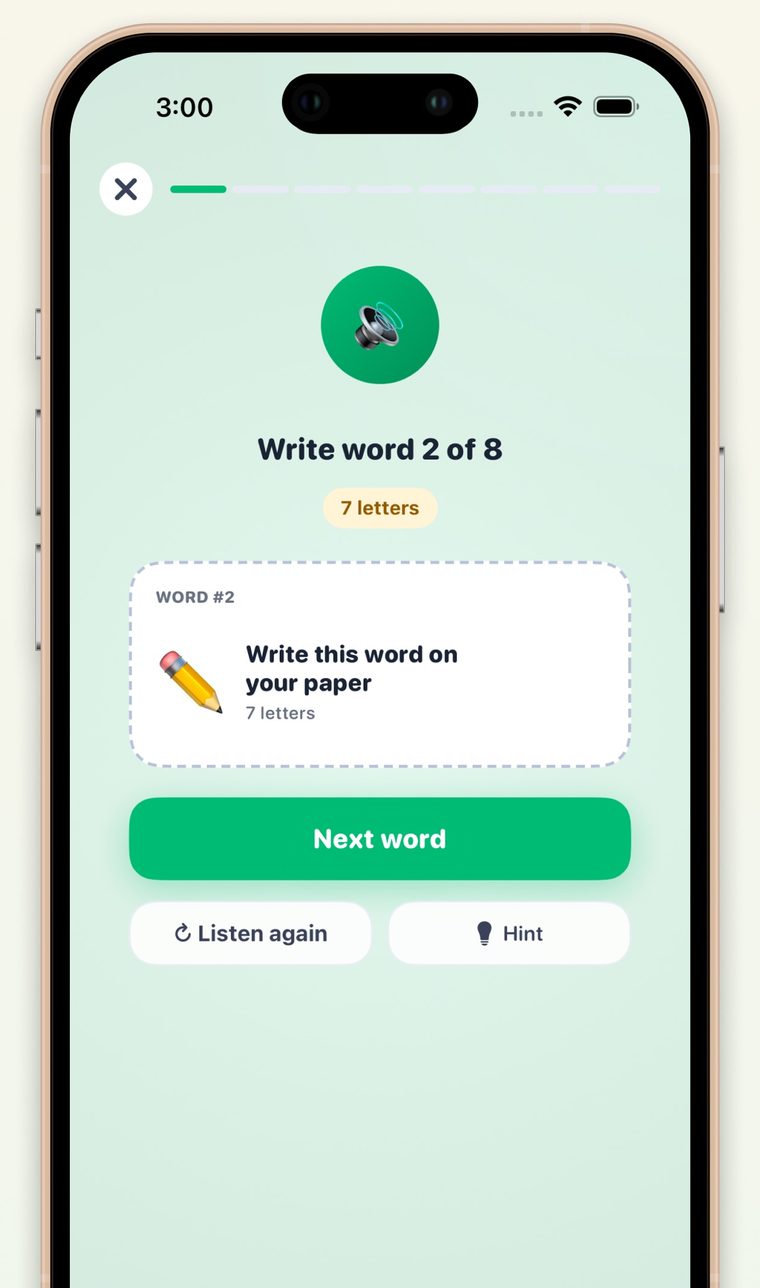
Word Wonder's Snap & Learn mode is the KS2 format without the teacher: the app reads eight words, your child writes them on paper, and one photo of the page marks every word letter by letter. Set the English variant to UK so that colour and practise are the accepted forms.
The Year 3 to Year 6 material sits in Word Wonder levels 5 to 10: soft c, -ing and un- in the lower levels, Greek and Latin roots and the -ation suffix higher up. The placement test decides where your child joins. What the app does not cover is Paper 1; grammar and punctuation are a different skill and a different 50 marks. How the paper compares with the Scripps bee and ICAS is set out in the exams section of the homepage.
On the day
The spelling paper is usually sat on the same morning as Paper 1, in the second week of May. Children should hear every word at least twice, so tell yours that asking for a repeat is allowed if they missed it. A word they are unsure of should still be attempted; a blank scores the same as a wrong answer, and a phonetic guess is sometimes right.
Questions parents ask
Is the KS2 spelling test timed?
Not strictly. The guidance says Paper 2 should take approximately 15 minutes, and the administrator moves at a steady pace through the 20 words. Children are not cut off mid-word, and the pace is set by the reader rather than a clock on the wall.
How many marks do you need to pass the KS2 spelling test?
There is no separate pass mark for spelling. The 20 spelling marks are combined with the 50 marks from Paper 1 and converted to a scaled score, and a scaled score of 100 or above meets the expected standard. The raw-mark threshold for 100 changes slightly each year.