iPhone & iPad · Phonics to exam vocabulary
Spell daily.
Score higher.The spelling app for kids aged 4+
Word Wonder is a spelling app for children aged 4 and up. It reads each word aloud, your child spells it on the keyboard or on paper, and 3,800 words across 16 adaptive levels carry them from first phonics to secondary-school English, one word at a time.
Free to start No ads Works offline
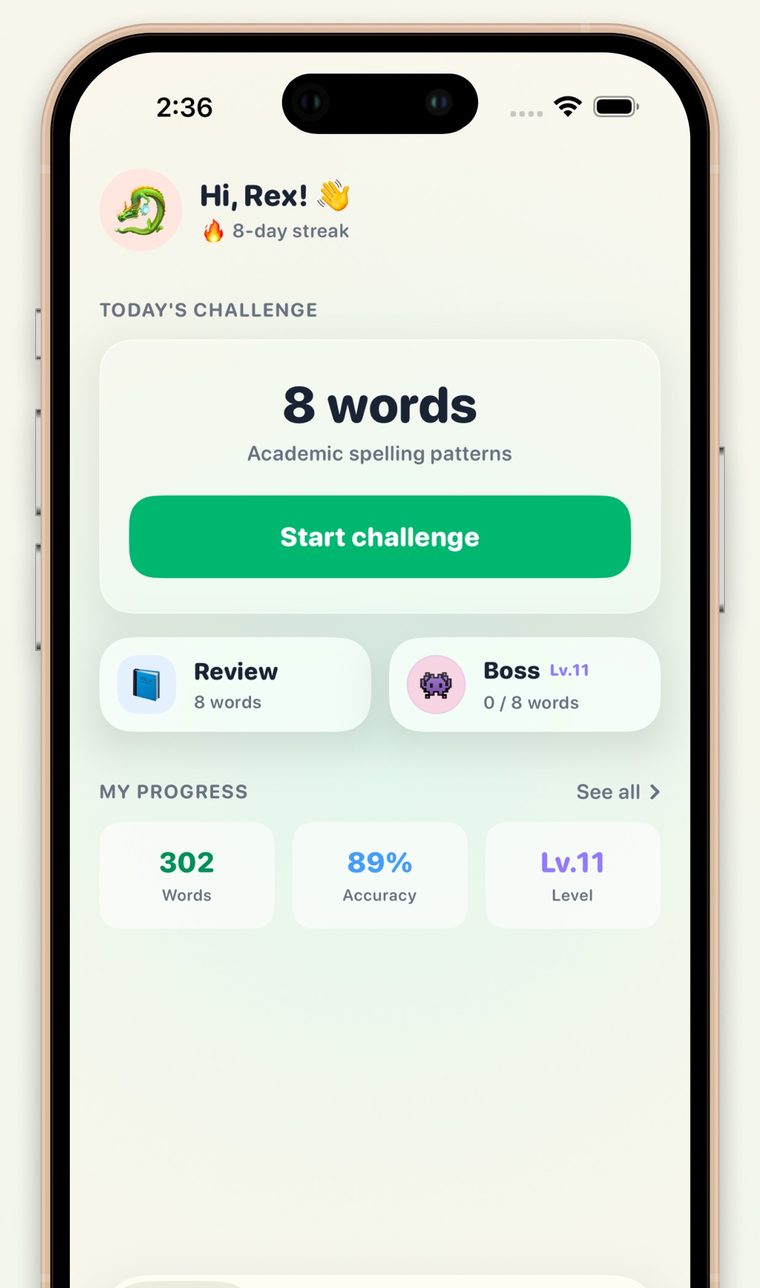
How it works
Three steps, one school night at a time
No grade to guess at, no worksheet to print. Word Wonder finds the level, sets the pace, and keeps the reward in sight.
Find the right start
A short, friendly placement test climbs in strides (four levels, then eight, then twelve) until it finds where your child actually is. Nobody starts on words they already know, or on words they cannot reach.
Practise eight words a day
The Daily Challenge is deliberately small: a set your child finishes before attention runs out. Hear the word, spell it, get instant and encouraging feedback.
Beat the boss, unlock the next level
Every level ends with a Boss Fight, and each word spelled right lands a hit. Sixteen bosses stand between Wriggle the caterpillar and Apex, every one of them a milestone worth telling someone about.
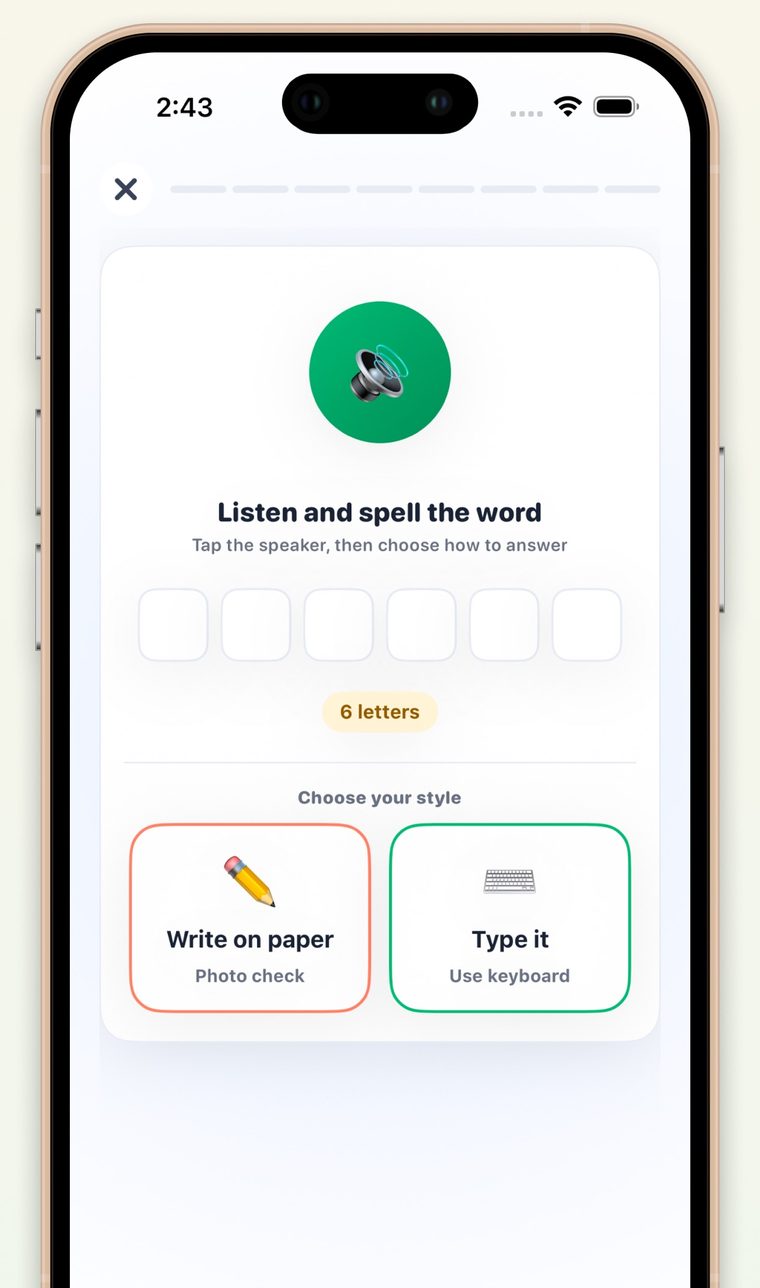
Listen & Spell
Hear the word. Spell the word.
Every word is spoken aloud in clear US or UK English. Your child taps the speaker as often as they need. No time pressure, and no penalty for listening twice.
- Letter boxes show the word's length, so a guess is never blind
- A meaning hint is one tap away, and never gives the spelling away
- Wrong answers are shown letter by letter, not marked with a cross
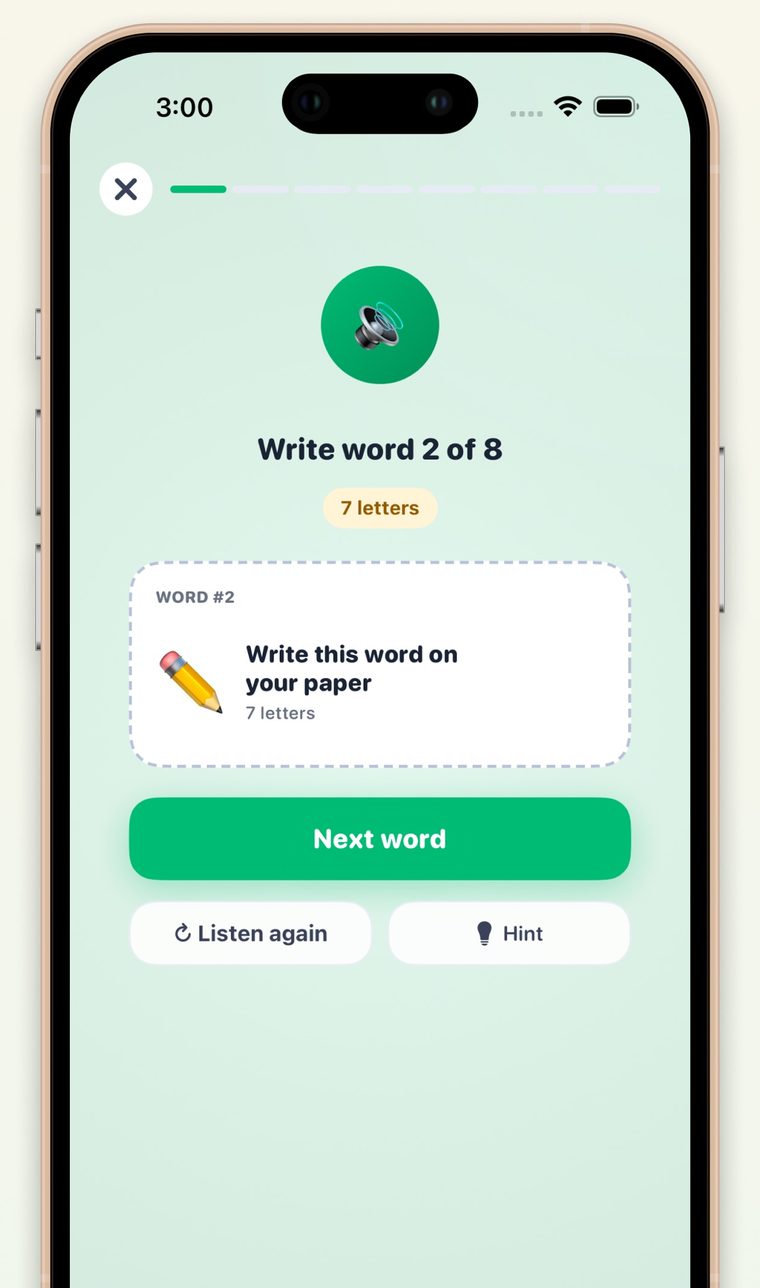
Snap & Learn
Real dictation, on real paper
Spelling is a handwriting skill, and school tests are written by hand. Word Wonder reads the list aloud, your child writes it on paper, then photographs the page, and the app checks every word, letter by letter.
Prefer the keyboard? Typing is always an option; your child picks at the start of every word.
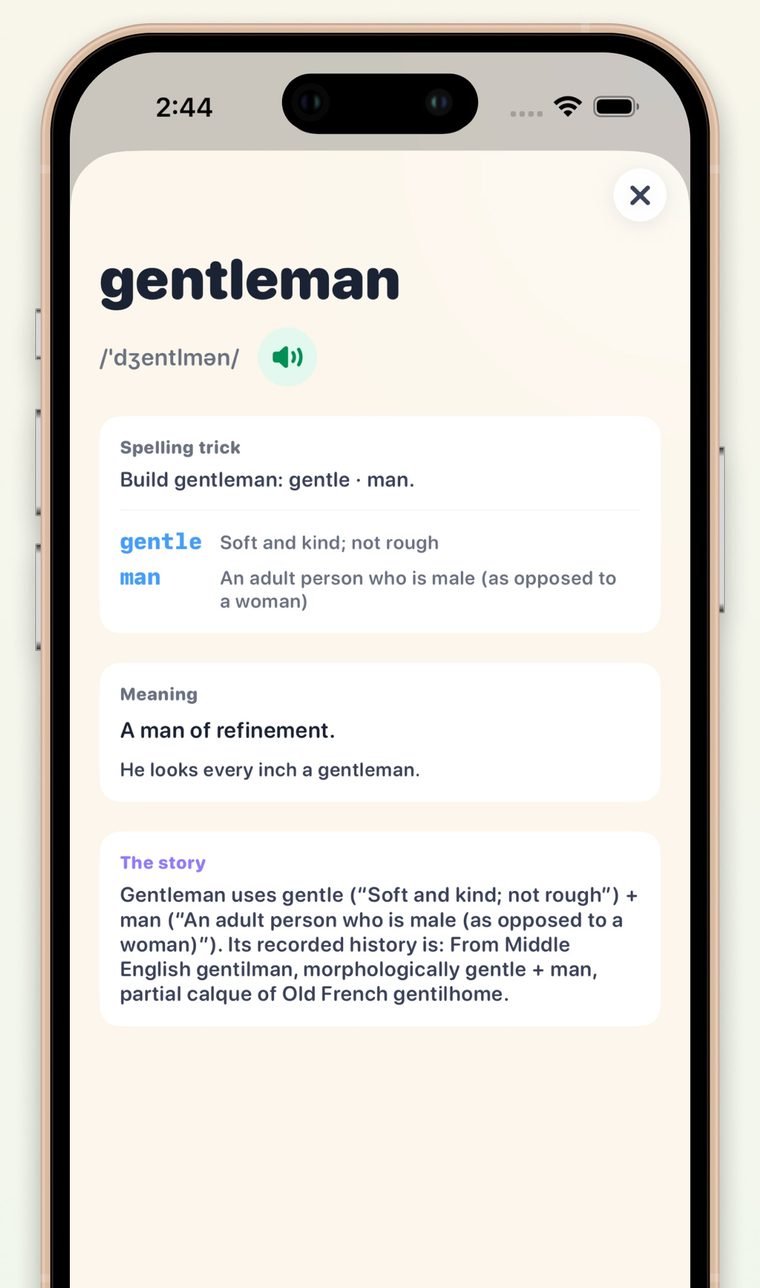
Word detail
Know why it spells that way
Rote memorising fades. Children learn a word for good once they can see how it is built, so Word Wonder opens every one up: the parts it is made of, what each part means, the pronunciation, and the story of where it came from.
Spelling trick
The story
From Middle English gentilman, a partial calque of Old French gentilhomme.
Smart review
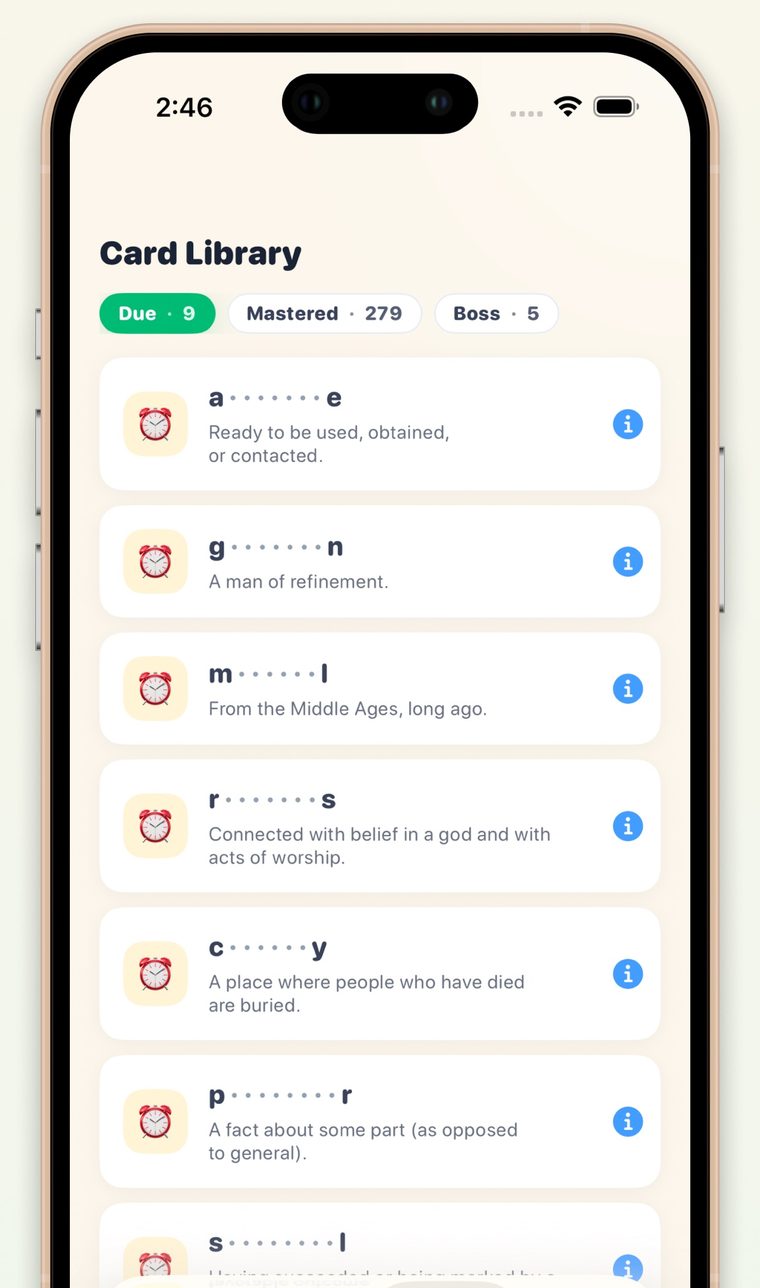
Tricky words come back at the right moment
Spaced repetition schedules each word for the day it is about to be forgotten. Mastered words step aside; the stubborn ones keep showing up until they stick.
Progress
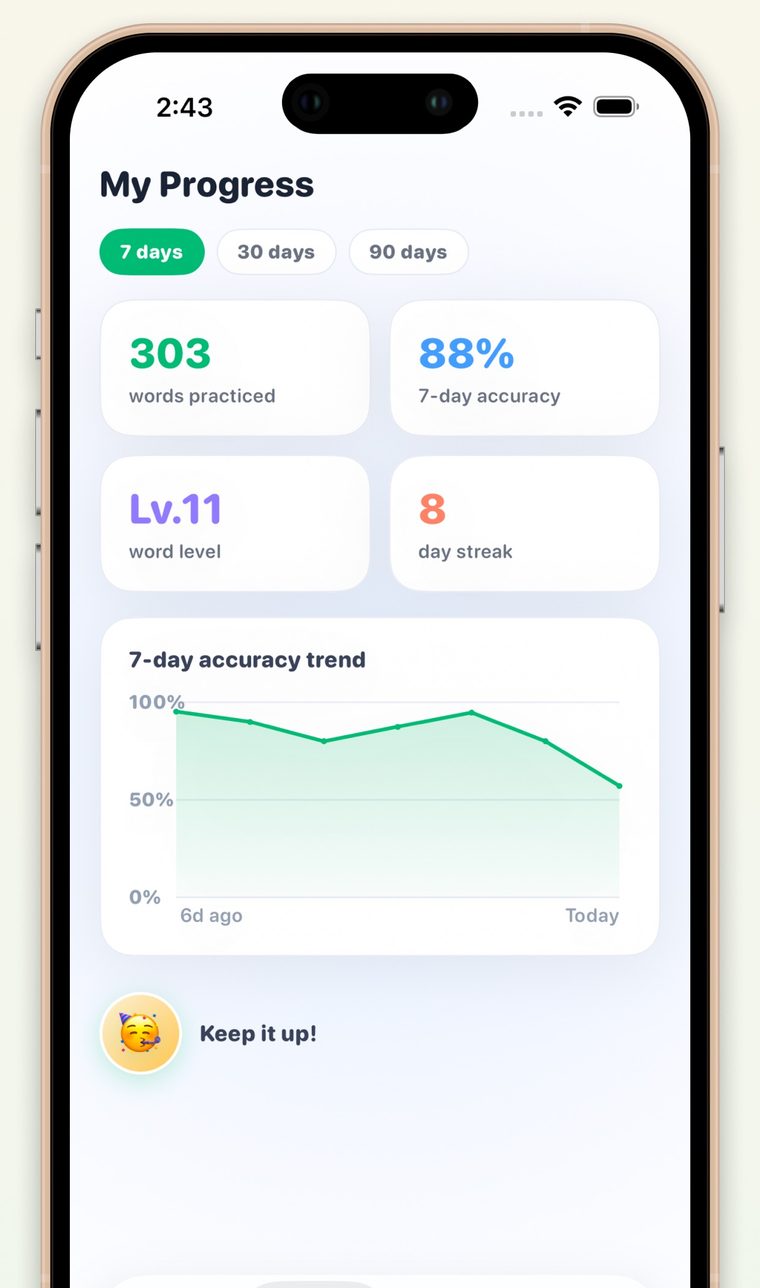
One screen tells you how it's going
Words practised, accuracy trend, current level, streak, over 7, 30 or 90 days. Enough to spot a wobble early, without turning a child into a dashboard.
Boss fights
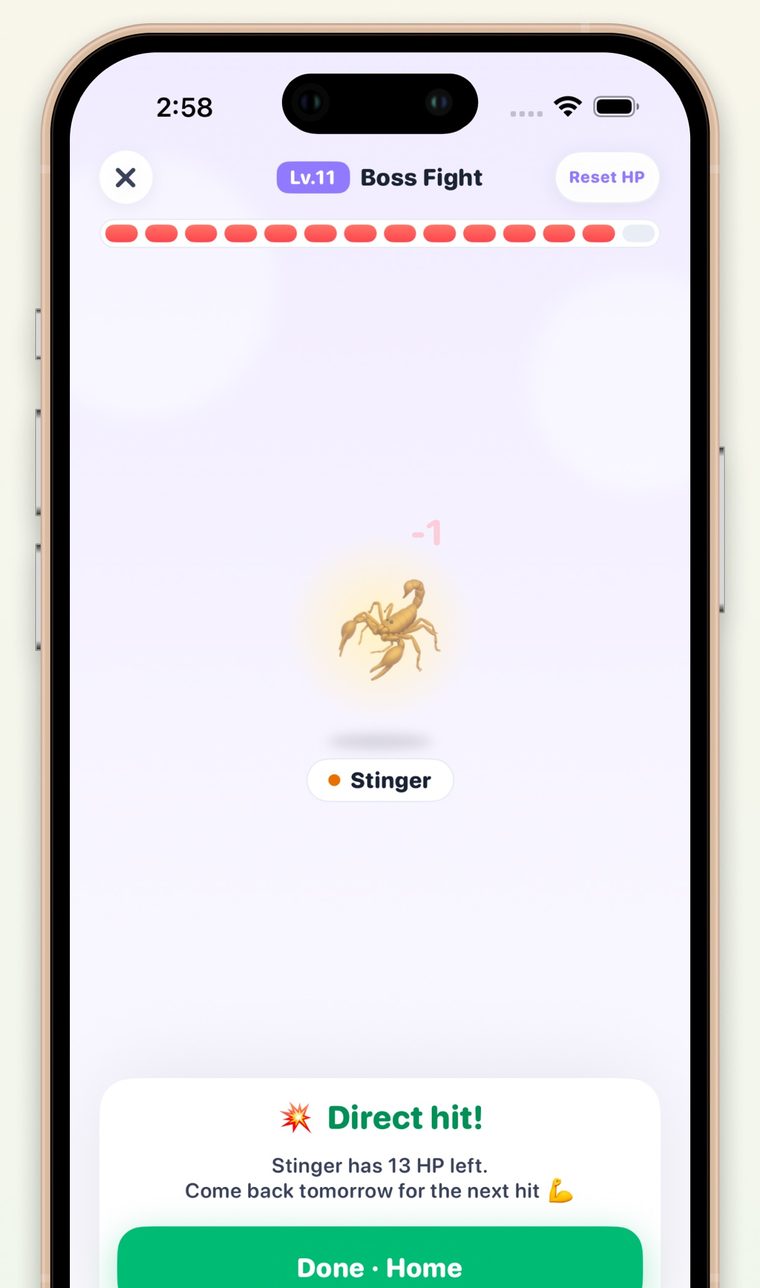
Sixteen bosses. Sixteen milestones.
A level isn't finished until its boss is beaten. Every word spelled right lands a hit, so the reward for revision becomes a story your child wants to tell at dinner.
- 🐛WriggleLv.1
- 🫧BubblesLv.2
- 🦇FlitLv.3
- 👻BooLv.4
- 🐙OctoLv.5
- 🤖RustyLv.6
- 🐲PuffLv.7
- 👹CycloLv.8
- 🧙HexerLv.9
- 🐉DrakoLv.10
- 🦂StingerLv.11
- 🦈RazorLv.12
- 🦖RexorLv.13
- 🦅TempestLv.14
- 🐍VortexLv.15
- 👾ApexLv.16
The ladder
16 levels that grow with your child
One shared ladder that spans the whole arc of English literacy, from a preschooler's first phonics to secondary-school vocabulary. The placement test decides where your child joins it; their birthday does not.
Year bands are the app's own curriculum tags, taken straight from the word library. Older learners and families building English as a second language often use levels 13–16 as vocabulary groundwork long before they meet an SAT or PTE word list.
Exams
Three countries, three papers, one skill
Britain's KS2 spelling paper, America's Scripps bee, Australia and New Zealand's ICAS Spelling Bee. Nothing alike on the timetable, and all three come down to the same moment: a word read aloud, spelled cold. That moment is Word Wonder's daily loop.
KS2 SATs · spelling paper
Year 6 · every May · England
Paper 2 of the English grammar, punctuation and spelling test: 20 words in 15 minutes. Each word is read inside a sentence, then repeated on its own: dictation, in context.
Sits on Word Wonder levels 5–10
Scripps National Spelling Bee
Classroom → school → regional → state → national
The official study list, Words of the Champions, runs to 4,000 words in three tiers: One Bee for school bees, Two Bee for regionals, Three Bee for state and national. A pronouncer says the word; you spell it back.
Draws on the whole ladder, levels 1–16
ICAS Spelling Bee
Years 2–7 (Australia)
35 to 50 questions in 40 minutes, sat on your child's own device with headphones in. Audio dictation, plus the spelling rules and conventions behind the words.
Sits on Word Wonder levels 1–12
What a good result actually looks like
KS2 · a scaled score
Scores run 80 to 120. 100 is the expected standard. Reach it and your child has met it; below it is “working towards”.
Scripps · you advance, or you don't
- Classroom bee
- School bee
- Regional bee
- State bee
- National finals
There is no grade. You either move up a level or your bee is over for the year, which is why the study list matters more than the practice paper.
ICAS · certificates, ranked nationally
- ICAS Medaltop of the region
- High Distinctiontop 1%
- Distinctionnext 10%
- Creditnext 25%
- Meritnext 10%
- Participationeveryone else
What can be promised about a grade, and what can't
Two of those three are ranks. An ICAS certificate and a Scripps placing are decided by how everyone else did on the day, so no app, tutor or workbook can honestly promise your child a Distinction; the band is only ever 10% of whoever turned up. The KS2 expected standard is different: it is a threshold, and a threshold is something you can genuinely aim at.
What daily practice moves, in all three cases, is the same quiet number: how many of the words on that paper your child has already met out loud, months before the day.
What Word Wonder drills
- Dictation under pressure. A word heard once and spelled cold, the exact thing every one of those papers measures.
- Rules and conventions. Suffix rules, doubling, silent letters, Greek and Latin roots: the patterns the words are built from, rather than a list to memorise.
What it doesn't
- Proofreading and error correction. ICAS Spelling Bee tests it. Word Wonder doesn't drill it; that one still belongs to reading and to school.
- Grammar and punctuation. That is Paper 1 of the KS2 test, and a different skill entirely.
ICAS is run by Janison. The Scripps National Spelling Bee is run by The E.W. Scripps Company. Key Stage 2 tests are set by the UK's Standards and Testing Agency. Word Wonder is independent, and is not affiliated with, endorsed by or connected to any of them.
For parents
Built to be handed to a child unsupervised
No ads, no outside links
Nothing in the app leads anywhere else. There is no feed, no chat, and nothing to buy inside a lesson.
Works without a signal
The word library ships inside the app and the audio is generated on the device, so a car journey or a plane is practice time. Only iCloud sync needs the internet.
US or UK English
Pick one and both the pronunciation and the accepted spelling follow it: color or colour, never marked wrong for living in the wrong country.
A pace a child can keep
Eight words a day, then done. The app never nags for a longer session or a bigger streak.
Review timed by the forgetting curve
Spaced repetition rather than a random shuffle. Words return on the day they are most likely to be slipping.
Progress you can read in ten seconds
Words practised, accuracy, level and streak, over 7, 30 or 90 days, and synced to every device by iCloud.
Where the words come from
Levelled against published curricula
Not an algorithm's guess at what a seven-year-old should know. Every level is checked against national spelling curricula and word-frequency data.
Guides for parents
Spelling, explained for parents
How children learn to spell, how the tests work, and how to run practice at home. Written by the Word Wonder team, with sources.
What the ICAS Spelling Bee tests for Years 2 to 7, how the awards are ranked, and a home practice plan built on daily dictation and spelling rules.
6 min read The KS2 Spelling Test Explained for ParentsHow the Year 6 SATs spelling paper works: 20 words read in sentences, scaled scores from 80 to 120, and how to practise at home from September to May.
5 min read Spelling Words by Grade and Year: What to ExpectWhich spelling patterns children meet from preschool to Grade 9, with example words at each stage, and how spelling bee lists differ from school lists.
6 min read How Children Learn to Spell: From Phonics to RulesThe stages children pass through in learning to spell, from letter sounds to word parts, what each stage looks like on paper, and how to help at each one.
6 min read Spelling Dictation at Home: A 10-Minute RoutineHow to run spelling dictation at home in ten minutes: choose eight words, read them the way tests do, mark by letter, and schedule the ones that come back.
6 min read Best Spelling Apps for Kids in 2026, ComparedSix spelling apps for kids compared on price, age range and what they drill. Checked on the US App Store in August 2026 by the makers of Word Wonder.
6 min readQuestions
Before you download
What age is Word Wonder for?
Rated 4+ and built for early readers upward. The placement test sets the starting level rather than the child's age, so a nine-year-old rebuilding confidence and a five-year-old meeting their first phonics both land somewhere sensible. Learn more →
Does my child need to be able to type?
No. Every word offers two ways to answer: type it on the keyboard, or write it on paper and photograph the page. Younger children who write faster than they type lose nothing. Learn more →
Does Word Wonder work offline?
Yes. The word library ships inside the app, the audio is generated on the device, and handwriting is read on the device too, so daily practice works with no signal at all. Only iCloud sync and purchases need a connection.
Will it help with KS2, a Scripps bee or ICAS?
Word Wonder is a spelling curriculum rather than a test-prep course: there are no past papers here, and nobody can promise you a rank. What it builds is what all three papers measure, hearing a word once and spelling it cold, and knowing the rule underneath it. Learn more →
Which words does my child get at each level?
Levels 1 to 4 cover short vowels, blends and sight words; 5 to 10 move through suffixes, prefixes and Greek and Latin roots; 11 to 16 carry secondary-school and academic vocabulary. Each level is tagged to a school year band from the curricula it was checked against. Learn more →
Can two children share one iPad?
Not yet. Word Wonder keeps one child profile per device, with its own nickname, avatar, level and streak. Two children on a single install would share a level and a review queue, so separate devices or Apple accounts work better today.
Is Word Wonder free?
Free to download and start. Word Wonder Premium, an auto-renewing monthly or yearly subscription with a free trial for new subscribers, unlocks unlimited practice, Boss Fights and smart review. Cancel any time in App Store settings.
How is Word Wonder different from other spelling apps?
Most spelling apps quiz on screen. Word Wonder also marks handwriting from a photo, places the child by a test instead of by age, and schedules review by the forgetting curve. It has no ads and no custom-list feature, so it suits daily practice better than a weekly school list. Learn more →
Tonight's spelling practice could be eight words and a boss fight
Free to start. No ads. Nothing in the app leads anywhere but the next word.
Download on theApp Store Requires iOS 17 or later · iPhone and iPad · 17 MB