Guide for parents
Best spelling apps for kids in 2026, compared honestly
The best spelling app for a child depends on the job: a free official list for a Scripps bee (Word Club), a games-first companion to a school programme (Spelling Shed), a one-off purchase with no subscription (Simplex Spelling Phonics 1), a broad early-learning app that includes phonics (Khan Academy Kids, Hooked on Phonics), or daily adaptive dictation with handwriting marking (Word Wonder). None of them does everything, and the table below says which does what.
A disclosure first: we make Word Wonder. This comparison exists because parents ask us how it differs, and the honest answer includes cases where another app is the better pick. Every price and rating below was checked on the US App Store on 27 August 2026 and will drift; treat the table as a snapshot.
The comparison
| App | Price | Age rating | What it is for | Store rating |
|---|---|---|---|---|
| Word Wonder (Kids Spelling – Word Wonder) | Free; Premium subscription, monthly or yearly, free trial | 4+ | Daily adaptive dictation, 3,800 words in 16 levels, handwriting marked from a photo, spaced review, US/UK English, offline | New (Aug 2026), no ratings yet |
| Word Club (Scripps National Spelling Bee) | Free | 12+ | The official 4,000-word Scripps study list with flash cards and quizzes; One, Two and Three Bee tiers | 4.1 (905) |
| Spelling Shed (EdShed) | $2.99 one-off | 4+ | Spelling games used by schools; pairs with a school or family EdShed account | 4.3 (519) |
| Simplex Spelling Phonics 1 (Pyxwise) | $4.99 one-off, no in-app purchases | 4+ | 450 high-frequency words in 42 pattern-based lists with lessons; last updated 2019 | 4.1 (22) |
| Hooked on Phonics Learning | Free download, 7-day trial, then monthly subscription | 4+ | Reading, math and spelling for ages 3–8; three learner profiles; ebook library | 4.5 (17,805) |
| Khan Academy Kids | Free, no subscription | 4+ | Broad early-learning curriculum for ages 2–8 including phonics; nonprofit | 4.8 (129,526) |
What matters more than the feature list
Five things separate spelling apps that change a child's spelling from the ones that get deleted in a fortnight.
- Audio. Spelling is tested by ear. An app that shows the word and asks the child to rearrange letters is a reading exercise.
- Handwriting. Tests are written by hand. Most apps drop this entirely; Word Wonder marks a photographed page.
- Placement. Whether the app finds the child's level or asks you to pick a grade. Picking a grade is usually a band wrong.
- Review timing. Whether missed words come back on a schedule (spaced repetition) or in a random shuffle.
- What else is on the screen. Ads, feeds, outbound links and chat. For a child using an app alone, none of these belongs.
Word Club: the right pick for a Scripps bee
If your child is entering a US classroom or school bee, start here. It is free, it is made by Scripps, and it contains the 4,000 words on Words of the Champions that the 2026–27 bees are drawn from, split into One Bee, Two Bee and Three Bee. The trade-offs: it is rated 12+, requires iOS 18, is list-based rather than adaptive, and does not teach spelling rules. It is a study tool for a syllabus, and a good one.
Spelling Shed: games alongside a school programme
Spelling Shed is used in thousands of schools, mostly in the UK, and the iOS app is a $2.99 one-off. Its strength is variety: several arcade-style games built on the same word lists, plus vocabulary games. It works best when your child's school already runs EdShed, because the lists then match what is being taught that week. On its own, expect to manage lists yourself.
Simplex Spelling Phonics 1: one payment, one year of lists
Simplex is the one app here with no subscription and no in-app purchases: $4.99 buys 450 high-frequency words in 42 lists, each with a lesson on the pattern it teaches, and the developer cites a classroom study showing spelling gains. The catch is age: the app was last updated in October 2019, which shows in the interface, and it targets one year of early spelling rather than a ladder.
Hooked on Phonics and Khan Academy Kids: spelling inside a bigger programme
Both are early-learning platforms rather than spelling apps. Hooked on Phonics covers reading, maths and spelling for ages 3 to 8 behind a monthly subscription after a seven-day trial, with three child profiles per account. Khan Academy Kids is free and ad-free, run by a nonprofit, and includes phonics within a wide curriculum for ages 2 to 8. If your child is under seven and spelling is one of several things you want covered, either is a sensible home. Neither drills dictation or handwriting, and neither runs past early primary.
Word Wonder: daily dictation with a pencil
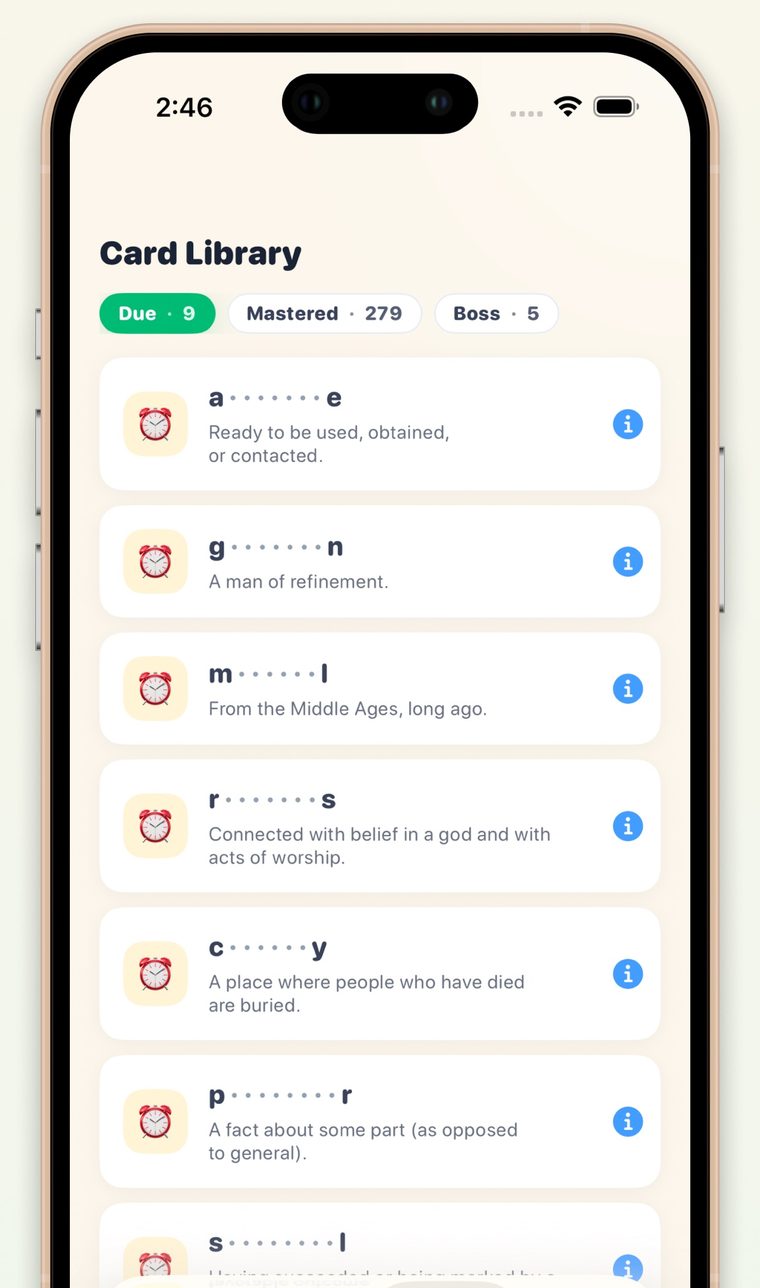
Word Wonder is built around one loop: hear a word, spell it by keyboard or on paper, and have the misses return on schedule. A placement test sets the level, 3,800 words run from first phonics to Grade 9 vocabulary, each word opens into its parts and origin, and the whole thing works offline with no ads or outbound links. It drills the dictation format that KS2, Scripps and ICAS share. It is free to start; Premium is a monthly or yearly subscription with a free trial.
Where it is the wrong pick: it does not import a school's weekly list, it has one child profile per device, it does not drill proofreading, and it launched in August 2026 with no track record of store ratings yet. If any of those is the deciding factor, one of the apps above fits better.
Which to pick, by situation
| You want to… | Start with |
|---|---|
| Prepare for a Scripps classroom or school bee | Word Club, then Word Wonder for daily dictation |
| Practise the exact list the school sent home | Spelling Shed, if the school uses EdShed |
| Pay once and never see a subscription | Simplex Spelling Phonics 1 |
| Cover reading, maths and spelling for a 4-year-old | Khan Academy Kids (free) or Hooked on Phonics |
| Build spelling by ear and by hand, from phonics to secondary vocabulary | Word Wonder |
| Prepare for KS2 or ICAS dictation | Word Wonder, plus the official practice paper for the format |
Free, subscription or one-off
Free apps here are free for a reason worth knowing: Word Club is funded by Scripps, Khan Academy Kids by donations. Subscriptions (Hooked on Phonics, Word Wonder Premium) pay for continued development and are the model to check for a free trial and an easy cancel. One-off purchases (Spelling Shed, Simplex) are the cheapest over a year, and the risk is the one Simplex shows: an app that stops being updated. There is no wrong answer, only a question of what you are paying for and for how long.
Questions parents ask
Are free spelling apps good enough?
For some jobs, yes. Word Club is the official Scripps list and costs nothing, and Khan Academy Kids is a complete early-learning curriculum with no subscription. Free apps tend to be list-based or broad rather than adaptive; if you need placement, spaced review or handwriting marking, those usually sit behind a subscription or a one-off price.
Can a spelling app replace school spelling lists?
It can replace the practice, not the list. A school list tells you which pattern the class is on this week, and a list-based app such as Spelling Shed can drill exactly those words. An adaptive app such as Word Wonder builds the underlying skill on its own curriculum, which helps with the school list indirectly but will not quiz the ten specific words due on Friday.