Guide for parents
How children learn to spell, from phonics to rules
Children learn to spell in stages. First they learn that letters stand for sounds and write words the way they hear them (frend, becos). Then they learn that English has patterns the ear cannot supply, such as silent e and doubled consonants. Finally they learn that words are built from parts with meanings, so that gentleman is gentle plus man and transportation carries port inside it. Phonics is the first of these stages, and it is the foundation for the other two rather than the whole building.
This guide describes each stage, what it looks like in a child's writing, and what kind of help suits it. It draws on Linnea Ehri's phases of word learning and J. Richard Gentry's stages of spelling development, both widely used by teachers.
Reading and spelling use the same knowledge
Decoding is turning letters into sounds; encoding, or spelling, is turning sounds into letters. They use the same letter-sound knowledge in opposite directions, which is why systematic phonics programmes teach both together. A child who can read ship has most of what they need to spell it, and a child asked to spell ship is rehearsing the knowledge that lets them read shop.
Spelling is the harder direction. Reading a word lets you recognise it from partial cues; spelling it means producing every letter in order. That is why children often read far above the level at which they spell, and why spelling practice tends to improve reading rather than the other way round.
The stages, side by side
| Stage (Gentry) | Phase (Ehri) | Typical age | What monster looks like |
|---|---|---|---|
| Precommunicative | Pre-alphabetic | 3–5 | Random letters or shapes: bTsL |
| Semiphonetic | Partial alphabetic | 4–6 | Some sounds represented: MSR |
| Phonetic | Full alphabetic | 5–7 | Every sound, spelled as heard: monstr |
| Transitional | Consolidated alphabetic | 6–9 | Patterns applied, sometimes wrongly: monstur |
| Conventional | Automatic | 8+ | monster, and knows why |
Ages are ranges rather than targets. Children move through the stages at different speeds and can sit in two at once, phonetic on new words and conventional on familiar ones.
Stage 1: marks that mean something
A three- or four-year-old who writes a string of letters and reads it back as "happy birthday" has understood the biggest idea in literacy: print carries meaning. They have not yet connected specific letters to specific sounds. Help at this stage is reading aloud, pointing at words, and letting them see you write. Correcting the letters would be correcting something they are not yet trying to do.
Stage 2: the first sounds land
MSR for monster shows a child who knows that letters stand for sounds and has caught the loudest ones. Initial and final consonants usually come first, vowels last. This is where phonics teaching begins to pay off directly: the child is asking, in effect, which letter makes which sound, and a scope-and-sequence of letter sounds answers the question in the right order.
Stage 3: phonetic spelling, and why it is good news
Frend, becos, monstr. Every sound is there, in order, spelled with a plausible letter. Parents often worry at this stage, and it is the stage to celebrate: the child has fully decoded speech into letters. What they lack is knowledge of English's irregularities, and that arrives through seeing words, many times, in print.
Help now is gentle exposure rather than drilling: reading, word games, and dictation of words that follow rules cleanly. Marking every phonetic spelling wrong teaches the child that the effort of listening carefully does not pay, which is the opposite of the lesson.
Stage 4: patterns, applied and over-applied
The transitional speller has learned that spelling is not purely sound. Silent e appears, sometimes where it does not belong (hoping for hopping). Vowel teams show up (ea, ai) in roughly the right places. The classic sign is the over-generalised rule: finded for found, because the child has learned -ed.
This is the stage for explicit rules, one at a time. Doubling before -ing. Dropping e before a vowel suffix. i before e except after c, along with the words that ignore it. Dictation is the right tool here because the child can apply a rule they have just been taught and see whether it held.
Stage 5: words as built things
Conventional spellers spell monster correctly and can tell you that separate has "a rat" in it. The knowledge that makes this stage stick is morphology: prefixes, roots and suffixes with meanings. A child who knows port means carry has transport, import, portable and transportation without four separate acts of memory.
English is layered: Anglo-Saxon words (house, friend) follow one set of habits, Latin words (separate, necessary) another, Greek words (photograph, chorus) a third. Older children who are told which layer a word comes from make better guesses at the letters, and etymology stops being trivia.
How much practice, and how spaced
Timothy Shanahan, summarising the research on Reading Rockets, puts the number of meaningful encounters needed to learn a word at roughly 10 to 15, with children who struggle needing 12 to 25. Copying a word ten times in a row does not count as ten encounters; ten encounters spread across days, each requiring the child to produce the word from memory, does.
That is the case for short, frequent sessions with words coming back at widening intervals. Eight words a day, with the misses returning in two days and again in a week, outperforms a Sunday-night list every time it has been measured.
Where Word Wonder fits
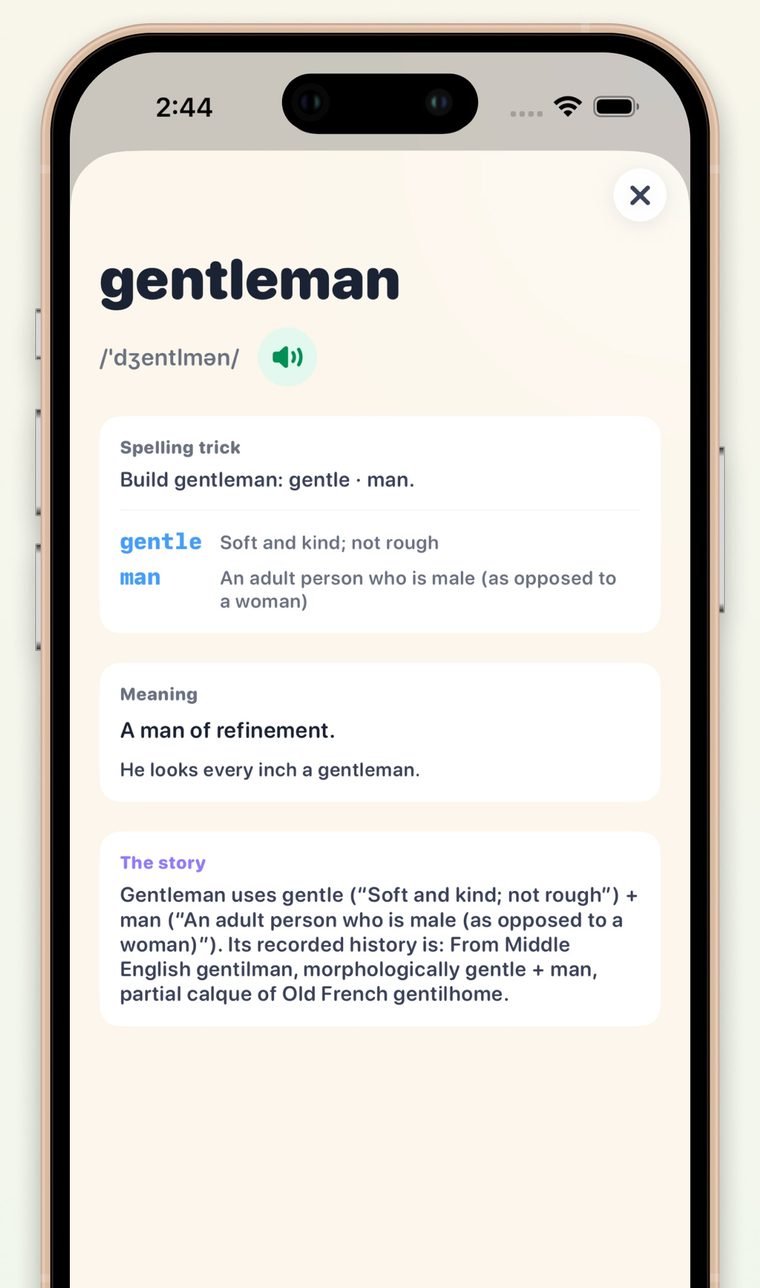
Word Wonder begins at the phonetic stage (levels 1 to 4: short vowels, blends, sight words) and runs to the morphological one (levels 9 to 16: roots, suffixes, academic vocabulary), with a placement test choosing the entry point. Every word opens into its parts, meaning and origin, the way gentleman does in the screenshot above, and words return on a spaced schedule. Children answer by typing or by writing on paper and photographing it, which keeps the handwriting link intact.
Which words live at which level is set out in the word list by grade guide, and the dictation routine is the paper-and-pencil version of the same loop.
Questions parents ask
At what age should a child spell correctly?
Most children reach broadly conventional spelling of everyday words between eight and ten, with new and academic vocabulary still being learned well into secondary school. Phonetic spelling at six or seven is on schedule. What matters more than the age is that the child is moving through the stages rather than stuck at one.
Is it normal for a 7-year-old to spell phonetically?
Yes. Writing "becos" or "frend" at seven shows the child hears every sound and maps it to a letter, which is the stage most seven-year-olds are in. It becomes a concern only if the same phonetic spellings persist at nine or ten with no sign of pattern knowledge appearing, at which point a chat with the class teacher is worthwhile.