Guide for parents
Spelling dictation at home: a ten-minute routine
Spelling dictation at home takes ten minutes and needs a pencil, paper and a list. Read each word once inside a short sentence and once on its own, let your child write it by hand, then mark it letter by letter rather than with a tick or cross. Words spelled wrong go on a comeback list and return two days later, then a week later. Twice a week is the minimum that works; five short sessions beat two long ones.
Dictation is how spelling is tested in most of the world, from the Year 6 SATs paper in England to the ICAS Spelling Bee in Australia to a classroom bee in the United States, so practising it at home also rehearses the test format. Here is the routine, step by step, followed by what to do when it goes wrong.
- Choose eight words. Pick eight words at your child's real level, ideally grouped by one pattern. Add two words missed last time.
- Read each word the way tests do. Say the word, then a short sentence containing it, then the word again. Speak plainly and do not stretch the syllables.
- Let them write by hand. Pencil and paper, one word per line. No looking at the list. Allow a repeat if asked, but not a third.
- Mark letter by letter. Show which letter was wrong and write the correct word beside it. Do not use crosses.
- Keep a comeback list. Misses return in two days, then a week, then a month. A word spelled right three times in a row is done.
Why dictation, and not copying
Copying a word five times exercises the hand. Dictation exercises memory: the child must retrieve the letters with nothing to look at, which is the act every test asks for and the act that builds a lasting spelling. Research on learning letter-sound relationships through writing, summarised by literacy teachers such as those at All About Learning Press, points the same way: children learn spelling as they produce it with feedback, not as they trace it.
Dictation also trains listening. A child who has to catch necessary from one clear reading is practising the attention the exam room requires.
What you need
A pencil, lined paper, a list of eight to ten words, and a quiet ten minutes. Headphones are optional but useful if a test in your country is delivered through audio, as the ICAS Spelling Bee is. That is the whole kit. Anything more elaborate tends to become the reason the session does not happen.
Step 1: choose eight words
Eight is a number a seven-year-old can finish before attention runs out, and it leaves room for two comeback words without the list feeling long. Group them by pattern where you can: eight -tion words teach the pattern; eight unrelated words teach eight facts. If the school sends a list, use it. If not, the words-by-grade guide has example words at each stage.
Pitch the list so that your child gets roughly three-quarters right on the first attempt. All right means the list is too easy; fewer than half means it is a band too hard, and it is better to drop back than to push on.
Step 2: read it the way the test does
Word, sentence, word. "Necessary. It is necessary to wear a coat. Necessary." The sentence gives meaning, which is what separates their from there, and it is the format the KS2 paper uses. Say the word in your ordinary accent at ordinary speed. Stretching it into syllables helps today and hurts on the day, because nobody will do that in the exam.
If your child asks for a repeat, give one. A third reading is where the routine starts drifting from the test.
Step 3: write by hand
Tests are handwritten, and handwriting appears to help spelling memory in its own right: the movement of forming the letters in sequence is one more cue for recall. Keep the list out of sight. One word per line leaves room for corrections beside it.
Step 4: mark letter by letter
A cross says "wrong". A circle around the c in neccessary says "one letter too many, here". The second is information a child can use; the first is a verdict. Write the correct spelling alongside, and if a rule explains it, name the rule in a sentence. Then move on. Long explanations at this point turn a ten-minute routine into a twenty-five-minute one that nobody wants to repeat on Thursday.
Step 5: keep a comeback list
The comeback list is where the learning is. A word spelled wrong tonight should be dictated again in about two days, then a week after that, then a month. Each time it is spelled right, the gap widens; each time it is wrong, the gap resets. This is spaced repetition, and the schedule below is a workable version of it on paper.
| Result | Next appearance |
|---|---|
| Wrong tonight | In 2 days |
| Right once | In 1 week |
| Right twice | In 1 month |
| Right three times in a row | Retired |
| Wrong at any point | Back to 2 days |
Typical children need around 10 to 15 spaced encounters with a word before it is secure, according to Timothy Shanahan's reading of the research, and more if spelling is hard for them. A comeback list is how those encounters happen without anyone having to remember which word was missed when.
How often
Twice a week is the floor recommended by most literacy teachers. Five minutes a day is better than either, because the comeback intervals work properly when there is a session to come back to. Pick a slot that already exists, after dinner or before the bedtime story, and attach the routine to it.
When it goes wrong
They refuse
Cut the list to four words for a week. Let them dictate to you for one of the sessions, and misspell something. The routine survives if it stays short and predictable; it dies the first week it becomes a scene.
They get everything wrong
The list is a band too hard. Drop back to words they get mostly right and rebuild. Confidence is a spelling skill; a child who expects to fail stops listening carefully.
They get everything right
Move up a band, and add a homophone pair inside sentences. The test writers will.
You keep forgetting
This is the most common failure and the least discussed. The fix is either a fixed slot on a fixed day or handing the routine to something that does not forget.
Letting the app run it
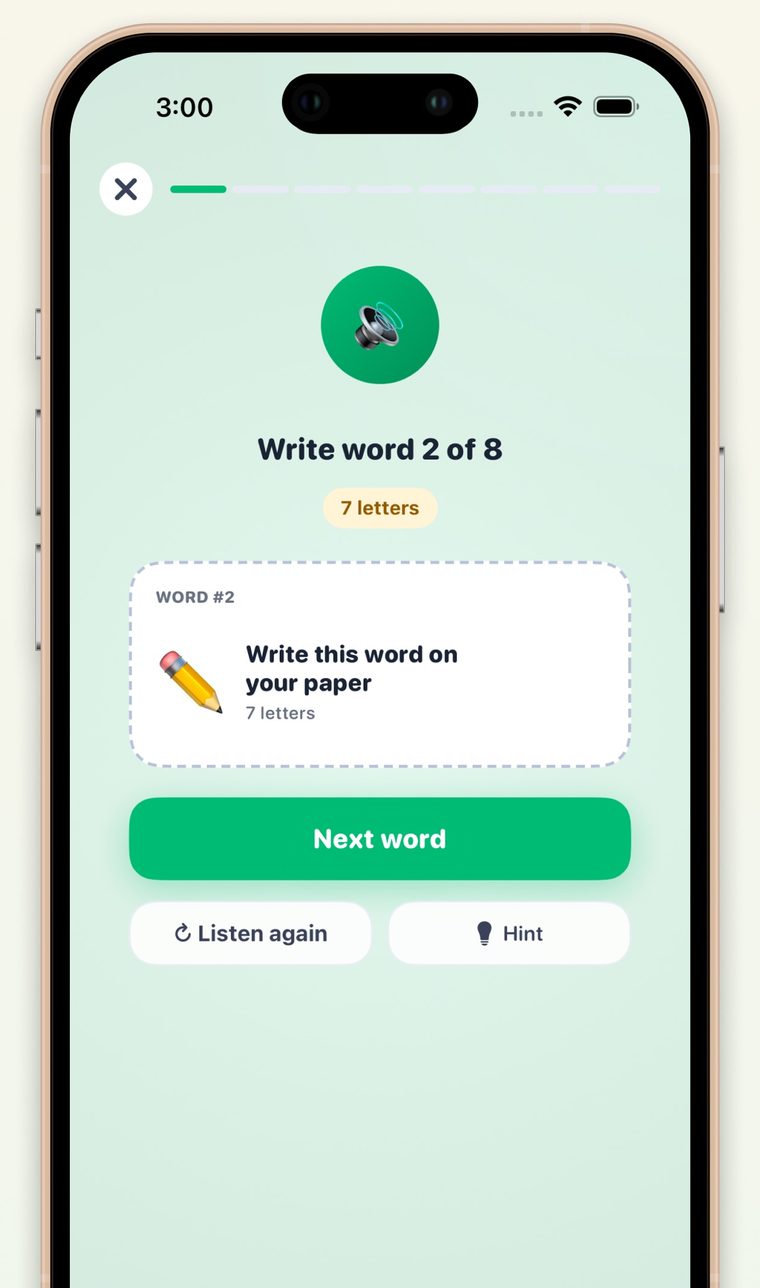
Word Wonder's Snap & Learn mode is this routine with the reading, marking and comeback list automated. The app speaks eight words at your child's placed level, your child writes them on paper, and a single photo of the page marks every word letter by letter. Misses return on the day the forgetting curve says they will. The paper, the pencil and the handwriting stay exactly as above; what changes is that the session happens on the nights you are tired too.
If your child prefers to type, that is always offered at the start of each word. Either way, the loop above is the one the app is running.
Questions parents ask
How long should spelling dictation take?
Ten minutes for eight to ten words, including marking. If it regularly runs past fifteen, the list is too long or the explanations are. Two short sessions on different days teach more than one long one, because the gap between them is where the remembering gets tested.
Should I correct spelling mistakes straight away?
Yes, at the end of the list rather than after each word, and by showing which letter went wrong rather than marking the word with a cross. Immediate, specific feedback is what makes dictation work; a delayed or vague correction leaves the wrong spelling as the last thing the child wrote.