Guide for parents
Spelling words by grade and year: what to expect at each stage
Spelling words are not handed out by grade at random. Each year's list teaches a set of patterns: short vowels and blends in the first two years, suffixes and prefixes in the middle years, Greek and Latin roots after that, and subject vocabulary in secondary school. Knowing which pattern a list is teaching is what lets you help with it, and it is why a list for the wrong grade teaches almost nothing.
This guide sets out the six stages, with example words at each one, lines up US grades with UK and Australian years, and explains how a spelling bee list differs from the list that comes home from school.
The six stages at a glance
The bands below come from the curriculum tags in Word Wonder's word library, which was checked against English Appendix 1 (England), the Common Core State Standards (US) and the Australian Curriculum v9. The example words are taken from the library at each band.
| Stage | US grade | UK year | What the list is teaching | Example words |
|---|---|---|---|---|
| Early readers | Pre-K to Grade 1 | Reception to Year 2 | Short vowels, consonant blends, sight words | cat, sun, island, friend |
| Lower primary | Grade 2–3 | Year 3–4 | Soft c, -ing, un-, the port root | circle, kicking, unhappy, transport |
| Upper primary | Grade 4–5 | Year 5–6 | Greek and Latin roots, -ation | photograph, autograph, transportation, imagination |
| Lower secondary | Grade 6–7 | Year 7–8 | Unstressed vowels, silent letters in long words | absorb, aerial, scandal, sincere |
| Mid secondary | Grade 8 | Year 9 | Science and humanities vocabulary | bacteria, synthetic, strategic, tolerance |
| Upper secondary | Grade 9 | Year 10 | Abstract and academic vocabulary | integrity, liability, detrimental, equivalent |
Australian year levels run one ahead of US grades and match UK years closely: Australian Year 3 is roughly US Grade 2 and English Year 3. The table's UK column works for Australia and New Zealand with that in mind.
Preschool to Grade 1: sounds become letters
The first lists are almost entirely phonetic. Cat, sun, hop and bed teach that each sound gets a letter. Blends follow: st, bl, tr. Then the first sight words arrive, the ones that cannot be sounded out and simply have to be known: the, said, friend, island.
A child at this stage who writes frend is doing well. They have heard every sound. What they have not yet met is the rule that some words break the rules, and that comes with exposure rather than correction. Our guide to how children learn to spell covers what this stage looks like on paper.
Grades 2 and 3: the first rules
Second and third grade lists introduce the idea that spelling has rules. Soft c before e, i and y (circle, city). Doubling a consonant before -ing (hopping but hoping). The un- prefix flipping a meaning. Compound words such as afternoon and birthday, and contractions.
In England this is Years 3 and 4, and the first 100-word statutory list applies. A typical school list at this stage has ten to fifteen words a week grouped by one pattern, and the pattern is the thing to name when you practise: "these are all doubling words".
Grades 4 and 5: roots and long words
Upper primary lists start building words from parts. Photo plus graph; auto plus graph; trans plus port plus -ation. A child who knows that graph means writing can spell autograph, paragraph and photograph without learning them three times.
This is also where the KS2 spelling paper sits in England. The Year 6 test draws on everything from Year 2 onward, but its hardest words are the Year 5–6 statutory list: necessary, occasionally, rhythm, conscience.
Grades 6 to 9: vocabulary takes over
From lower secondary the challenge changes. The words are longer, and the difficulty is no longer the rule but the unstressed vowel nobody pronounces: the second a in separate, the e in sincere, the i in definite. Silent letters hide inside longer words, and subject vocabulary from science and humanities arrives in quantity: bacteria, synthetic, tolerance.
By Grade 9 the lists are academic: integrity, liability, equivalent. Spelling these is mostly a matter of having read them, which is why wide reading beats any list at this stage.
School lists versus spelling bee lists
A school list is pedagogical: ten words teaching one pattern. A spelling bee list is a syllabus: the Scripps National Spelling Bee's Words of the Champions runs to 4,000 words in three tiers (One Bee, Two Bee, Three Bee), and the official Word Club app carries all of them free of charge. Bee words are chosen for difficulty and for interesting etymology rather than for the pattern they teach, so a bee list contains bouillabaisse next to brooch.
Bee preparation therefore leans on roots and language of origin. School preparation leans on the weekly pattern. Both come down to the same act on the day, hearing a word and spelling it, so dictation is the common practice. The homepage compares the three main papers that test it.
How to use a grade list at home
Start from the child, not from the grade. A quick dictation of twelve mixed words from the table above tells you which band to work in, and the answer is often not the band on the school timetable. Ten words a week, dictated in sentences and marked by letter, with the misses returning two days later and again a week on, is enough. The dictation routine covers the mechanics.
Where Word Wonder fits
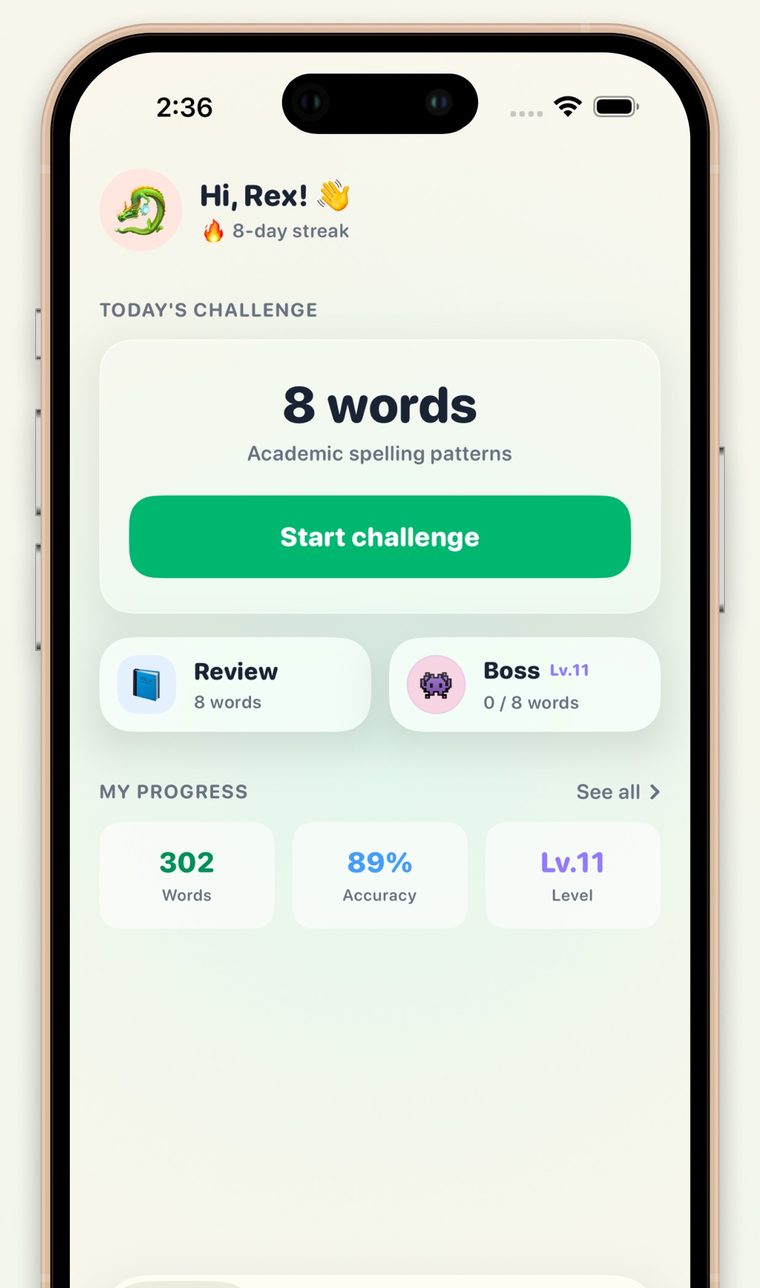
Word Wonder holds the six stages above as 16 levels and 3,800 words, and a placement test picks the level instead of the birthday. Each word opens up into its parts and origin, which is the roots-based habit that upper-primary lists and bee lists both reward. It does not import a school's weekly list; if you need that, one of the list-based apps is a better fit for that job.
Questions parents ask
Should my child's spelling list match their grade?
Only if their spelling matches their grade, which is true for perhaps half of children at any moment. A short mixed dictation tells you the real band in ten minutes. A list one band too hard teaches frustration; one band too easy teaches nothing; the right band shows up as roughly 70 to 85 percent correct on first attempt.
What if my child is behind their grade in spelling?
Go back to the band where they are getting most words right and work forward from there. Spelling builds on itself, so a Grade 5 child who never settled the doubling rule needs the Grade 2–3 list for a few weeks, and there is no shame in it. Most catch up faster than parents expect once the missing rule is in place.